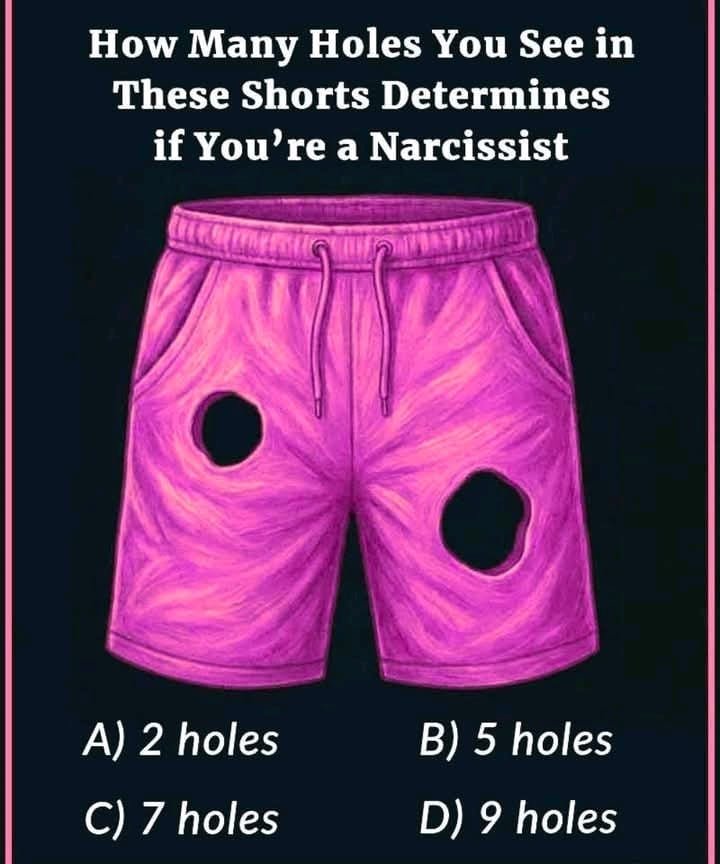
How Many Holes You See in These Shorts—and Why It Doesn’t Actually Determine If You’re a Narcissist
Seen the viral shorts illusion? Here’s why the number of holes you spot says more about perception than personality—and what psychology really says.
Introduction
You’ve probably seen it scrolling through social media:
A picture of a pair of shorts.
A bold claim.
“The number of holes you see reveals if you’re a narcissist.”
Some people say 4.
Others swear it’s 6.
A few confidently argue 8 or more.
Then comes the twist—labels, judgments, and dramatic conclusions about your personality.
It’s fun. It’s intriguing. It’s also… not how psychology works.
Let’s unpack what’s really going on here—why this illusion grabs attention so fast, what the holes actually represent, and why personality traits like narcissism cannot be diagnosed from a single image.
The Viral Shorts Illusion: What People Are Actually Seeing
The Image Itself
The image typically shows a pair of shorts laid flat, with:
-
Two leg openings
-
A waistband opening
-
Visible front and back holes created by perspective
Some viewers count only the obvious openings.
Others include interior or overlapping openings created by depth and fabric folds.
That’s where the disagreement begins.
How Many Holes Are There Technically?
Let’s break it down logically:
-
Waist opening → 1
-
Left leg opening → 1
-
Right leg opening → 1
That’s 3 physical openings.
However, due to perspective and visibility:
-
You can see both sides of the leg openings
-
The interior creates the illusion of additional holes
So people may reasonably count 4, 6, or even 8, depending on how they interpret visible spaces.
This is a perception task—not a personality test.
Why the Brain Disagrees on the Answer
This Is About Visual Processing, Not Ego
Your brain constantly fills in gaps based on:
-
Depth perception
-
Prior experience
-
Attention to detail
-
Whether you focus on objects or spaces
Some people count functional holes.
Others count visible openings.
Neither approach is wrong—they’re just different cognitive styles.
Where the “Narcissist” Claim Comes From
The Psychology Buzzword Problem
“Narcissist” has become a viral label because it’s:
-
Emotionally charged
-
Easy to provoke reactions
-
Widely misunderstood
True narcissism—specifically Narcissistic Personality Disorder (NPD)—is a clinically defined condition diagnosed through long-term behavioral patterns, not images.
No licensed psychologist would ever assess narcissism based on:
-
An illusion
-
A number
-
A one-time response
Why These Posts Spread So Fast
1. They Trigger Self-Reflection
People are naturally curious about what things “say” about them.
2. They Create Social Debate
Disagreement fuels comments, shares, and arguments.
3. They Offer Identity Labels
Even false labels feel meaningful when they seem personal.
4. They Use Pseudo-Psychology
Scientific language without scientific method is extremely persuasive.
What the Illusion Might Gently Suggest (If Anything)
If we’re being generous and realistic, the illusion may loosely reflect:
-
Detail-focused vs big-picture thinking
-
Concrete vs abstract interpretation
-
How you define an object’s function
That’s it.
It does not indicate:
-
Self-absorption
-
Lack of empathy
-
Grandiosity
-
Personality disorders
Common Mistakes People Make With These Tests
Mistake #1: Confusing Entertainment With Diagnosis
Viral posts are designed for engagement, not accuracy.
Mistake #2: Over-Identifying With Labels
Personality is complex and situational, not binary.
Mistake #3: Projecting Meaning Onto Others
Disagreeing on a visual task doesn’t reveal character flaws.
What Narcissism Actually Looks Like (Briefly, and Accurately)
Clinically, narcissism involves persistent patterns, such as:
-
Chronic need for admiration
-
Lack of empathy over time
-
Exploitation of others
-
Fragile self-esteem masked by confidence
It’s about behavior across relationships, not how someone counts holes in clothing.
Why Your Answer Still Feels Personal
Because the brain treats ambiguity + self-relevance as important.
When something:
-
Has no clear answer
-
Mentions your personality
-
Invites comparison
Your mind leans in.
That reaction is human—not narcissistic.
The Bottom Line
The number of holes you see in the shorts says nothing about whether you’re a narcissist.
It reflects:
-
Visual interpretation
-
Perspective
-
How your brain categorizes space
That’s it.
Enjoy the illusion. Debate it. Laugh about it.
Just don’t let a meme tell you who you are.