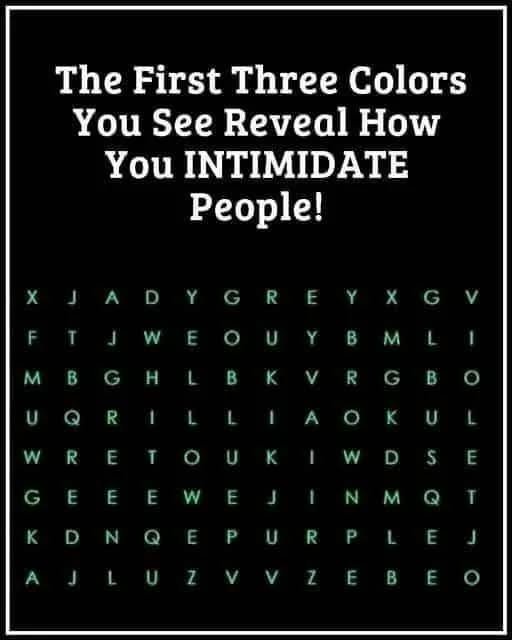
The First Three Colors You See Reveal How You Intimidate People—What Psychology Actually Says
Seen the viral color test? Learn what the first three colors you notice really say about perception, presence, and social psychology—without the hype.
Introduction
You glance at an image filled with colors.
Someone asks:
“What are the first three colors you see?”
Then comes the hook:
“Those colors reveal how you intimidate people.”
Suddenly, it feels personal.
People start comparing answers, reading interpretations, and wondering if others see them as intense, confident, distant, or overpowering—all from a split-second glance at colors.
It’s intriguing. It’s shareable.
But does it actually reveal anything real?
Let’s break down what’s really happening here—why color-based personality claims feel accurate, what psychology supports (and what it doesn’t), and how intimidation actually works in real social interactions.
Why Color-Based “Personality Tests” Feel So Convincing
These viral tests work because they tap into three powerful psychological effects:
1. Speed + Self-Relevance
You don’t analyze—you react. Fast reactions feel honest, even when they’re not diagnostic.
2. Ambiguity
Colors are emotionally loaded but undefined. That allows broad interpretations to feel specific.
3. Identity Curiosity
Anything suggesting insight into how others perceive us grabs attention immediately.
This isn’t manipulation—it’s human psychology.
What the “First Three Colors” Test Is Actually Measuring
Despite bold claims, this test does not measure intimidation.
What it may loosely reflect instead:
-
Visual attention patterns
-
Contrast sensitivity
-
Which colors stand out against a background for you
-
Mood, lighting, and screen settings at the moment
In other words: perception, not personality.
Two people with the same personality can see different colors first.
The same person can see different colors on different days.
Common Interpretations You’ll See Online (And Why They’re Vague)
You’ll often see claims like:
-
Red → You intimidate through intensity or passion
-
Black → You seem dominant or unapproachable
-
Blue → You intimidate through calm authority
-
Yellow → You overwhelm people with intelligence or energy
-
Green → You intimidate by being emotionally grounded
Notice something?
These traits are:
-
Broad
-
Mostly positive
-
Hard to disprove
This is known as the Barnum Effect—when general statements feel personally accurate.
Why “Intimidation” Is a Misleading Framing
In real psychology, intimidation is not a fixed trait.
People don’t find you intimidating because of:
-
A color you notice
-
Your aura
-
A hidden personality signal
They may feel intimidated due to contextual factors, such as:
-
Power dynamics (boss vs employee)
-
Confidence mismatch
-
Communication style
-
Body language
-
Social anxiety (theirs, not yours)
Often, intimidation says more about the other person’s internal state than about you.
What Actually Makes Someone Seem Intimidating
Research and social psychology point to a few consistent factors:
1. Strong Boundaries
People who don’t over-explain or over-apologize are often perceived as intimidating.
2. Comfort With Silence
Those who don’t rush to fill pauses can unsettle others—not because they’re harsh, but because they’re grounded.
3. Direct Communication
Clarity can feel intimidating to people who rely on indirect cues.
4. Confidence Without Seeking Approval
This is often misread as arrogance, especially in cultures that value likability.
None of these are revealed by a color test.
Why People Share These Posts Anyway
Because they’re fun—and because they spark conversation.
They invite comments like:
-
“I got red, black, blue—what does that mean?”
-
“This is so accurate!”
-
“No way, this doesn’t fit me at all”
Engagement thrives on disagreement and self-reflection.
That doesn’t make the posts harmful—but it does mean they’re entertainment, not insight.
Common Mistakes People Make With These Tests
Mistake #1: Taking Them Literally
They’re designed for intrigue, not evaluation.
Mistake #2: Letting Labels Stick
Being told you “intimidate people” can subtly change behavior—even if it’s not true.
Mistake #3: Ignoring Context
How you’re perceived changes by situation, culture, and relationship.
A Healthier Way to Interpret This Test
Instead of asking:
“How do I intimidate people?”
Try asking:
-
When do people seem uncomfortable around me?
-
In which settings do I feel most confident?
-
How do I communicate under pressure?
Those answers come from reflection and feedback, not colors.
Why the First Three Colors Still Feel Meaningful
Because noticing patterns—even imagined ones—helps the brain make sense of social uncertainty.
That’s not narcissism.
That’s not insecurity.
That’s being human.
The Bottom Line
The first three colors you see do not reveal how you intimidate people.
They reveal:
-
What stood out visually in that moment
-
How your attention filtered information
-
Nothing more
Real intimidation is situational, relational, and often unintentional.
Enjoy the test. Share it if it makes you smile.
Just don’t let a viral image define how you see yourself—or how you think others see you.