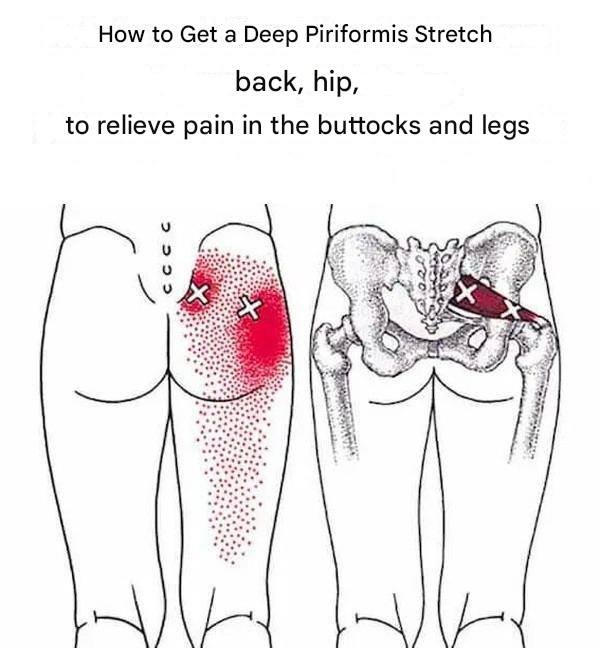
How to Get a Deep Piriformis Stretch to Eliminate Back, Hip, Glutes, and Leg Pain
Relieve back, hip, glute, and leg pain with deep piriformis stretches. Learn techniques, tips, and routines for long-lasting relief and mobility.
Introduction: Why the Piriformis Muscle Matters
The piriformis muscle is a small, pear-shaped muscle located deep in the buttocks, running from the sacrum to the top of the femur. Despite its small size, it plays a huge role in hip rotation, pelvic stability, and sciatic nerve function.
When tight, the piriformis can cause:
-
Lower back pain
-
Hip stiffness
-
Gluteal discomfort
-
Sciatica or leg pain
A deep piriformis stretch can relieve tension, improve mobility, and reduce pain in multiple areas.
1. Seated Figure Four Stretch
Step-by-Step Guide:
-
Sit on a chair with feet flat on the floor.
-
Cross your right ankle over your left knee (forming a “4” shape).
-
Keep your back straight and hinge slightly forward at the hips.
-
Hold the stretch for 30–60 seconds.
-
Switch sides.
Benefits:
-
Opens up the hips
-
Stretches glutes and lower back
-
Can be done anywhere
Tip: Keep your chest lifted to maximize piriformis engagement.
2. Lying Piriformis Stretch (Supine Figure Four)
Step-by-Step Guide:
-
Lie on your back with knees bent and feet flat on the floor.
-
Cross your right ankle over your left thigh.
-
Thread your hands through and grab the back of your left thigh.
-
Gently pull your left leg toward your chest until you feel a deep stretch in your right glute.
-
Hold for 30–60 seconds and repeat on the other side.
Benefits:
-
Deep glute and piriformis stretch
-
Reduces sciatic nerve compression
-
Gentle on the lower back
Tip: Avoid pulling too hard—stretch gradually.
3. Standing Piriformis Stretch
Step-by-Step Guide:
-
Stand upright near a wall or chair for support.
-
Cross your right ankle over your left knee (like a “figure four”).
-
Slowly bend the left knee and hinge slightly forward at the hips.
-
Hold for 20–40 seconds and switch sides.
Benefits:
-
Improves balance and flexibility
-
Can be used as a quick daily stretch
-
Great for office or home use
Tip: Keep your hips squared and core engaged for stability.
4. Pigeon Pose (Yoga-Inspired Stretch)
Step-by-Step Guide:
-
Start in a plank or downward dog position.
-
Bring your right knee forward, placing it behind your hands with the shin angled slightly.
-
Extend your left leg straight back.
-
Lower your hips toward the floor while keeping your back straight.
-
Hold for 30–90 seconds, then switch sides.
Benefits:
-
Deep hip and glute stretch
-
Targets piriformis and surrounding muscles
-
Helps improve hip mobility
Tip: Use a yoga block or pillow under your hip for support if needed.
5. Foam Roller Piriformis Release
Step-by-Step Guide:
-
Sit on a foam roller with one ankle crossed over the opposite knee.
-
Lean slightly toward the leg being stretched.
-
Roll slowly back and forth over the piriformis area for 1–2 minutes.
-
Switch sides.
Benefits:
-
Releases muscle tension and knots
-
Improves blood flow
-
Complements static stretching
Tip: Avoid rolling directly on the spine; focus on the glute and hip area.
Additional Tips for Piriformis Health
-
Warm Up First: Gentle walking or dynamic stretching helps loosen muscles.
-
Stretch Daily: Consistency is key for long-term relief.
-
Strengthen Surrounding Muscles: Glute, core, and hip-strengthening exercises prevent tightness from returning.
-
Posture Matters: Avoid sitting for long periods with poor posture.
-
Combine Stretching and Massage: Foam rolling or professional massage enhances results.
Frequently Asked Questions
1. Can piriformis stretches help sciatica?
Yes, stretching the piriformis can relieve sciatic nerve compression and reduce leg pain.
2. How long should I hold each stretch?
Hold for 30–90 seconds, repeating 2–3 times per side.
3. Can I do these stretches every day?
Yes, daily stretching improves flexibility, relieves tension, and prevents pain recurrence.
4. Do I need special equipment?
Most stretches require only a mat, chair, or foam roller—no expensive equipment needed.
Conclusion: Free Your Hips, Relieve Your Pain
Tight piriformis muscles can create discomfort that spreads to the back, hips, glutes, and legs. By incorporating deep piriformis stretches into your daily routine, you can:
-
Reduce pain
-
Improve mobility
-
Prevent injury
-
Enhance overall hip and lower back health
Call to Action
Take a few minutes every day to stretch, roll, and strengthen your piriformis. Share these stretches with friends and family to help everyone move pain-free.